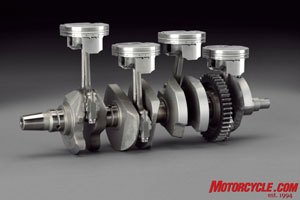
This new crankshaft arrangement is part of Yamaha’s latest YZF-R1, a literbike we tested last week at the Eastern Creek circuit in Australia, and it’s a design not seen in any previous production motorcycle.
The 998cc engine’s distinct sound is the obvious clue that it’s something special - it’s akin to a V-Four with a deep, purposeful note that seems a little bit angry. But it’s in the way the motor generates power that sets it apart from its competition. Gone is the peaky powerband of the previous motor, and in its place is the most tractable four-cylinder literbike yet built.
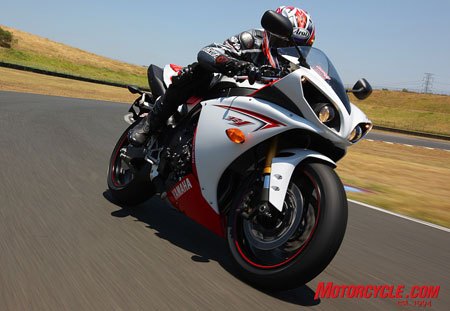 Yamaha’s 2009 R1 is ready to do battle against any of its literbike rivals. |
The newly enhanced midrange is welcome, but more than that is the feel of a direct connection between the throttle and rear tire. In most literbikes, a rider is acutely aware of the possibility of being high-sided to the moon if the throttle is applied injudiciously. With the R1, even a moderately skilled rider can safely drift the rear tire on corner exits.
| What’s a Cross-plane Crankshaft? | ||
|
As high-performance motorcycle engines have grown more powerful, it’s become difficult to harness that power through the small contact patch on the rear tire. A typical four-cylinder engine uses a flat-plane crankshaft, and the two outer and two inner pistons rise and fall in pairs, firing 180 degrees apart. Torque is applied to the crank during combustion, of course, but also from inertia as the crankshaft rotates. This inertial torque is seen as noise to engineers, and it has the effect of confusing a rider about the amount of traction available from a bike’s rear tire. The same holds true in the world of MotoGP racing, so Yamaha engineers introduced in 2004 an uneven firing interval for its inline four-cylinder M1 with what’s called a cross-plane crankshaft. In this new design the pistons are arranged 90 degrees apart from each other around the crank, which eliminates the inertial torque fluctuation of a typical four-cylinder mill. A balance shaft keeps vibration at tolerable levels. Yamaha has adapted this configuration to its R1 streetbike, providing enhanced traction and a very distinctive exhaust note we’ve been hearing from Valentino Rossi’s racebike. |
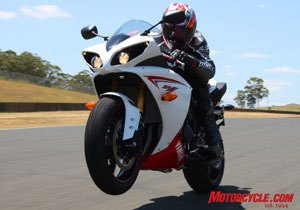
In the 600cc and 1000cc supersport categories, the successful mantra has always been lighter weight and more power. But with a claimed 182 crankshaft horsepower, the new R1 doesn’t re-set the bar in power production. And its 454 lb running weight (full of fuel, etc) is 15 up on the svelte Honda CBR1000RR.
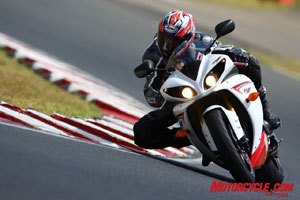 The R1 and its new engine configuration instills confidence to its rider. |
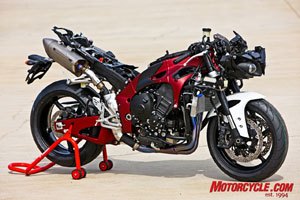 Other than the brake calipers, pretty much everything you see here is new to Yamaha’s R1. |
Instead, Yamaha has focused on its stated concept for the R1: “To deliver a maximum amount of drive force in the smoothest manner possible.” We’re happy to report that this isn’t just some PR hype - it’s actually something a rider can feel after just a short time in the saddle.
One of the knocks against the old R1 was its lethargic response when leaving stoplights. The new engine’s beefed-up midrange sure helps in this regard, aided by two extra teeth on the rear sprocket. Quick launches no longer require major clutch slippage, making around-town riding much easier to manage.
In terms of its chassis, the R1 doesn’t break as much new ground as its engine. Rake and trail remain unchanged, while the wheelbase is shortened by a scant 5mm. Nevertheless, the R1’s frame is an all-new design with a significantly revised rigidity balance.
Made from a mixture of gravity-cast, CF-cast and pressed-sheet aluminum, the frame is stiffer at the steering head and swingarm pivot, but its perimeter frame rails are now 37 percent more flexible laterally, providing greater feedback when the bike is leaned over in a corner. The swingarm also had its rigidity balance tweaked, allowing more flex laterally and torsionally.
Around the Eastern Creek circuit, the new R1 proved to be quite cooperative. Turn-in response is about what we’ve come to expect from a literbike, aided somewhat by the use of a taller 55-series rear tire rather than the typical 190/50-17. There are several mid-corner bumps around the Aussie racetrack, and the Yamaha was quite adept at sucking them up without throwing the bike off its trajectory.
Helping keep things stable is a nifty steering damper. Like the previous model, the damper has a check ball that engages when the handlebars wag back and forth too quickly. This mechanical system is aided by a new electronic component that engages a damper valve when vehicle speeds surpass 125 mph or when the throttle is twisted past the halfway point.
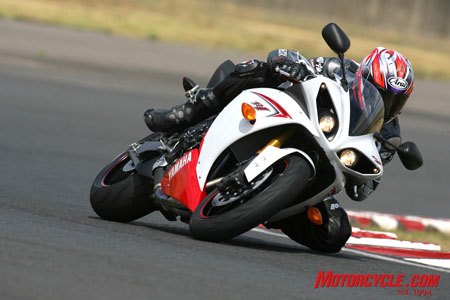 Even with street tires, the R1 encourages acute lean angles. We rode on Michelins, but US models will be fitted with Dunlop’s new D210 rubber. |
A totally new suspension system is up to the task of smoothing out the ride. Up front is a Soqi fork that has its damping circuits divided between each leg. Oil flow is simplified by having the left leg handle only compression damping and the right tube controlling only rebound damping. Yamaha reps claim this design minimizes cavitation (air mixing with the oil). At the rear, a bottom-link suspension has a more progressive ratio to make fuller use of its travel, and the addition of a hydraulic preload adjuster makes setting up the bike easier.
A revision to the engine architecture allowed it to be placed further forward in the frame, shifting the weight distribution slightly towards the front end. To best centralize mass, fuel is now carried lower between a rider’s legs and a lightweight magnesium subframe replaces an aluminum component.

No comments:
Post a Comment