Yamaha YZF-R 125Yamaha YZF-R 125
Yamaha YZF-R 125
google_protectAndRun("ads_core.google_render_ad", google_handleError, google_render_ad);
Make Model
Yamaha YZF-R 125 (R15)
Year
2008
Engine
Liquid cooled, four stroke, single cylinder, DOHC, SOHC, 4 valve
Capacity
124
Bore x Stroke
52 x 58.6 mm
Compression Ratio
11.2:1
Induction
Fuel Injection
Ignition / Starting
TCI / electric
Max Power
11 KW 15 hp @ 9000 rpm
Max Torque
12.2 Nm 1.25 kg-m @ 8000 rpm
Transmission / Drive
6 Speed / chain
Front Suspension
Telescopic forks, 130mm wheel travel
Rear Suspension
Swinging arm, 125mm wheel travel
Front Brakes
Single 292mm disc
Rear Brakes
Single 230mm disc
Front Tyre
100/80 -17
Rear Tyre
130/70 -17
Seat Height
818 mm
Dry-Weight
126.5 kg
Fuel Capacity
13.8 Litres
Monday, July 20, 2009

Friday, June 26, 2009
Yamaha YZF-R6
 | |
| Manufacturer | Yamaha |
|---|---|
| Also called | R6 |
| Production | 1999 - present |
| Predecessor | Yamaha YZF600R |
| Class | Sport bike |
| Related | Yamaha YZF-R1 |
In 2006, Yamaha advertised that the R6 had a redline of 17,500+ rpm. This is 2000 rpm higher than the previous R6 model and it was the highest tachometer redline of any 2006 production four-stroke motorcycle engine.
If it was actual Yamaha engine rpm, it would be near rpm levels known only in Formula One engines, where valve spring stress problems lead to the adoption of pneumatic valve actuation to handle more than 19,000 rpm.[1]
It was widely reported that the 2006 YZF-R6's motor did not have this engine rpm redline level and was closer to around 16,200 engine rpm, but because of a deliberate tachometer error of about 9%, it read 17,500 tachometer rpm. In February 2006, Yamaha admitted the bike's true engine redline was more than 1,000 rpm lower than displayed on the tachometer than advertised,[2] and offered to buy back any R6 if the customer was unhappy. According to general legend, nobody sold their bikes back to Yamaha.[3]
[edit] Specifications
All specifications are manufacturer claimed.
| 2001/2002[4] | 2003/2004[5] | 2005 | 2006/2007[6][7] | 2008/2009[8] | |
|---|---|---|---|---|---|
| Engine | |||||
| Type | 599 cc, DOHC, 16-Valve, Liquid-Cooled, In-Line Four-Cylinder | 600 cc (36.6 cu in), Liquid cooled, 4-stroke, forward inclined inline 4 cylinder, DOHC, 16 valves | 599 cc (36.5 cu in), liquid cooled, 4-stroke, forward inclined inline 4 cylinder, DOHC, 16-titanium valves | ||
| Bore x Stroke | 65.5 mm X 44 mm | 65.5 mm x 44.5 mm | 67.0 mm x 42.5 mm | ||
| Compression Ratio | 12.4:1 | 12.8:1 | 13.1:1 | ||
| Power (crank) | 99.6 kW (135 PS) @ 14,500 rpm with direct air induction / 94.9 kW (129 PS) @ 14,500 rpm without direct air induction[9] | ||||
| Carburetion | 37 mm Keihin CV Downdraft w/Throttle Position Sensor | Fuel injection | Fuel injection w/ YCC-T | Fuel Injection w/ YCC-T and YCC-I | |
| Ignition | Digital DC-CDI | TCI | |||
| Transmission | 6-speed w/multi-plate clutch | 6-speed w/multi-plate slipper clutch | |||
| Final Drive | #532 O-ring chain | #525 O-ring chain | |||
| Chassis | |||||
| Suspension/Front | Fully Adjustable 43 mm (1.7 in) Telescopic Fork, 5.3 in (134.6 mm) of Travel | 43 mm (1.7 in) telescopic fork w/adjustable preload, compression and rebound damping; 4.7 in (119.4 mm) travel | 41 mm (1.6 in) inverted telescopic fork w/adjustable preload, separate high & low-speed compression damping, rebound damping; 4.7 in (119.4 mm) travel | 41 mm (1.6 in) inverted fork; 4-way adjustable, 4.7 in (119.4 mm) travel | |
| Tires/Front | 120/60-ZR17 | 120/70-ZR17 | |||
| Tires/Rear | 180/55-ZR17 | ||||
| Dimensions | |||||
| Length | 81 in (2057.4 mm) | 79.7 in (2024.4 mm) | 80.3 in (2039.6 mm) | ||
| Width | 27.6 in (701 mm) | 27.2 in (690.9 mm) | 27.6 in (701 mm) | ||
| Height | 44.2 in (1122.7 mm) | 42.9 in (1089.7 mm) | 43.3 in (1099.8 mm) | ||
| Seat Height | 32.8 in (833.1 mm) | 32.3 in (820.4 mm) | 33.5 in (850.9 mm) | ||
| Wheelbase | 54.4 in (1381.8 mm) | 54.3 in (1379.2 mm) | |||
| Rake | 24 ° | ||||
| Trail | 3.4 in (86.4 mm) | 3.8 in (96.5 mm) | |||
| Fuel Capacity | 4.5 gal | 4.6 gal | |||
| Oil Capacity | 2.85 qt | 3.59 qt | |||
| Dry Weight | 399 lb (181 kg)[10] | 357 lb (162 kg)[11] | 366 lb (166 kg) [9] | ||
| Wet Weight | 185kg [12] | ||||
| Other | |||||
| Color | 2001: Team Yamaha Blue, Red 2002: Team Yamaha Blue, Red | 2003: Yamaha Racing Blue, Liquid Silver, Black w/ Flames 2004: Team Yamaha Blue, Liquid Silver w/ Flames, Rapid Red | 2005: Team Yamaha Blue, Rapid Red, Raven | 2006: Team Yamaha Blue, Raven, 50th Anniversary Yellow/Black 2007: Team Yamaha Blue, Charcoal Silver, Candy Red | 2008: Team Yamaha Blue/White, Raven, Liquid Silver, Cadmium Yellow w/Flames |
| Warranty | 1 Year (Limited Factory Warranty) | ||||
| MSRP (US$) | 2001: $7,999 (std model), $8,499 (Champions Limited Edition) 2002: ? | 2003: ? 2004: $8,099 (Blue, Red), $8,199 (Liquid Silver w/Flames) | 2005: $8,399 (Blue, Red), $8,499 (Raven) | 2006: $9,499 (50th Anniversary), $9,299 (Raven), $9,199 (Team Yamaha Blue) 2007: $9,299 (Team Yamaha Blue), $9,399 (Charcoal Silver, Candy Red) | 2008: $9,599 (Team Yamaha Blue/White, Raven, Liquid Silver), $9,799 (Cadmium Yellow w/Flames) |
R1
You might not yet know what a cross-plane crankshaft is, but you will. It’s a link to Valentino Rossi’s MotoGP bike, and it’s the biggest advancement in literbike engine design in years.
This new crankshaft arrangement is part of Yamaha’s latest YZF-R1, a literbike we tested last week at the Eastern Creek circuit in Australia, and it’s a design not seen in any previous production motorcycle.
The 998cc engine’s distinct sound is the obvious clue that it’s something special - it’s akin to a V-Four with a deep, purposeful note that seems a little bit angry. But it’s in the way the motor generates power that sets it apart from its competition. Gone is the peaky powerband of the previous motor, and in its place is the most tractable four-cylinder literbike yet built.
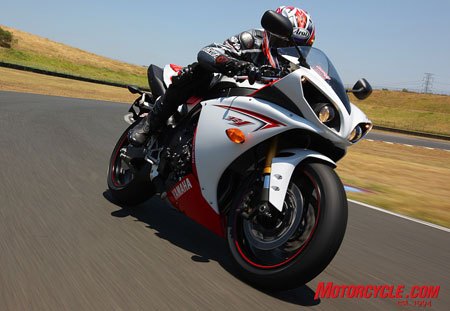 Yamaha’s 2009 R1 is ready to do battle against any of its literbike rivals. |
The newly enhanced midrange is welcome, but more than that is the feel of a direct connection between the throttle and rear tire. In most literbikes, a rider is acutely aware of the possibility of being high-sided to the moon if the throttle is applied injudiciously. With the R1, even a moderately skilled rider can safely drift the rear tire on corner exits.
| What’s a Cross-plane Crankshaft? | ||
|
As high-performance motorcycle engines have grown more powerful, it’s become difficult to harness that power through the small contact patch on the rear tire. A typical four-cylinder engine uses a flat-plane crankshaft, and the two outer and two inner pistons rise and fall in pairs, firing 180 degrees apart. Torque is applied to the crank during combustion, of course, but also from inertia as the crankshaft rotates. This inertial torque is seen as noise to engineers, and it has the effect of confusing a rider about the amount of traction available from a bike’s rear tire. The same holds true in the world of MotoGP racing, so Yamaha engineers introduced in 2004 an uneven firing interval for its inline four-cylinder M1 with what’s called a cross-plane crankshaft. In this new design the pistons are arranged 90 degrees apart from each other around the crank, which eliminates the inertial torque fluctuation of a typical four-cylinder mill. A balance shaft keeps vibration at tolerable levels. Yamaha has adapted this configuration to its R1 streetbike, providing enhanced traction and a very distinctive exhaust note we’ve been hearing from Valentino Rossi’s racebike. |
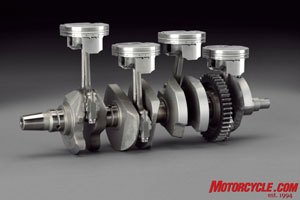
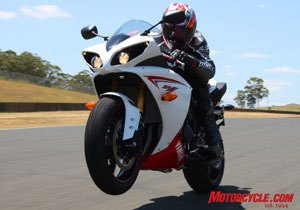
In the 600cc and 1000cc supersport categories, the successful mantra has always been lighter weight and more power. But with a claimed 182 crankshaft horsepower, the new R1 doesn’t re-set the bar in power production. And its 454 lb running weight (full of fuel, etc) is 15 up on the svelte Honda CBR1000RR.
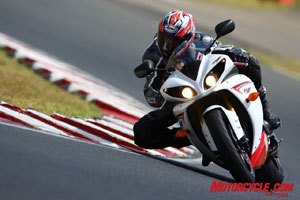 The R1 and its new engine configuration instills confidence to its rider. |
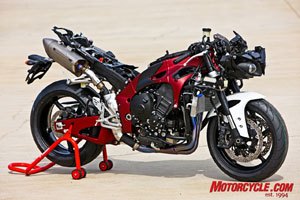 Other than the brake calipers, pretty much everything you see here is new to Yamaha’s R1. |
Instead, Yamaha has focused on its stated concept for the R1: “To deliver a maximum amount of drive force in the smoothest manner possible.” We’re happy to report that this isn’t just some PR hype - it’s actually something a rider can feel after just a short time in the saddle.
One of the knocks against the old R1 was its lethargic response when leaving stoplights. The new engine’s beefed-up midrange sure helps in this regard, aided by two extra teeth on the rear sprocket. Quick launches no longer require major clutch slippage, making around-town riding much easier to manage.
In terms of its chassis, the R1 doesn’t break as much new ground as its engine. Rake and trail remain unchanged, while the wheelbase is shortened by a scant 5mm. Nevertheless, the R1’s frame is an all-new design with a significantly revised rigidity balance.
Made from a mixture of gravity-cast, CF-cast and pressed-sheet aluminum, the frame is stiffer at the steering head and swingarm pivot, but its perimeter frame rails are now 37 percent more flexible laterally, providing greater feedback when the bike is leaned over in a corner. The swingarm also had its rigidity balance tweaked, allowing more flex laterally and torsionally.
Around the Eastern Creek circuit, the new R1 proved to be quite cooperative. Turn-in response is about what we’ve come to expect from a literbike, aided somewhat by the use of a taller 55-series rear tire rather than the typical 190/50-17. There are several mid-corner bumps around the Aussie racetrack, and the Yamaha was quite adept at sucking them up without throwing the bike off its trajectory.
Helping keep things stable is a nifty steering damper. Like the previous model, the damper has a check ball that engages when the handlebars wag back and forth too quickly. This mechanical system is aided by a new electronic component that engages a damper valve when vehicle speeds surpass 125 mph or when the throttle is twisted past the halfway point.
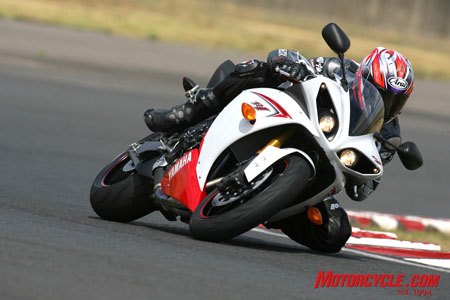 Even with street tires, the R1 encourages acute lean angles. We rode on Michelins, but US models will be fitted with Dunlop’s new D210 rubber. |
A totally new suspension system is up to the task of smoothing out the ride. Up front is a Soqi fork that has its damping circuits divided between each leg. Oil flow is simplified by having the left leg handle only compression damping and the right tube controlling only rebound damping. Yamaha reps claim this design minimizes cavitation (air mixing with the oil). At the rear, a bottom-link suspension has a more progressive ratio to make fuller use of its travel, and the addition of a hydraulic preload adjuster makes setting up the bike easier.
A revision to the engine architecture allowed it to be placed further forward in the frame, shifting the weight distribution slightly towards the front end. To best centralize mass, fuel is now carried lower between a rider’s legs and a lightweight magnesium subframe replaces an aluminum component.
Yamaha FZ16 Review and Road Test
This is perhaps the most sensational bike release in India. People are excited about the Yamaha FZ16 more than any other bike launch in the history. Why? Because it is not the big bike which a common Indian youth can’t afford. And it is not the sports bike with big flaring and sexy but unmanly looks. FZ16 changes the definition of street biking, its daring, strong, aggressive and unique. Join with me into a journey of exploring the various features of Yamaha FZ16. This is an exclusive review meant only for the readers of BikeAdvice!
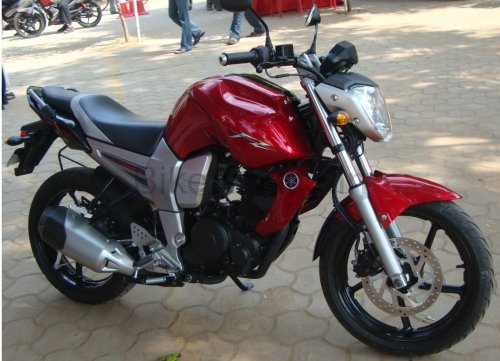
Looks and Styling: A magazine writer who has reviewed this bike tells me that this is the best looking bike in India. But I do not agree. Each kind of biker has a different taste. Some like smooth lines and big flaring, while some like the aggressive, naked and bold looks. I prefer the latter! Yes, this bike is the best looking one in the muscle segment.
Let not the pictures mislead you. The bike looks much better in real. The size of the tank looks massive. Even though the real tank hides itself from the outer make up, no one would know! When I saw the bike for the first time, I felt as if it spoke to me, “Hey, look I am here”. Definitely a head turner for sure. Even the majestic Bullet will look small near this bike. And I am sure that when you park the bike in your college parking lot, Splendors, Stars and Discovers will think twice before parking near Yamaha FZ16.
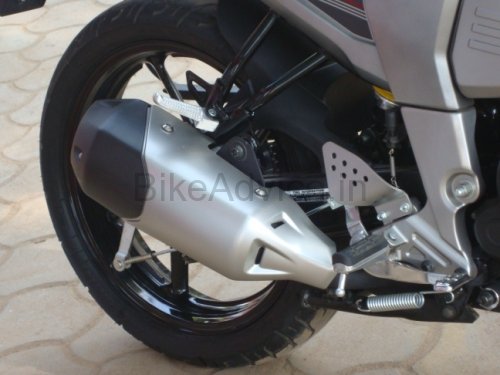
You can’t help from noticing the macho tires that add to the boldness of the bike. The 140mm rear tyre is the biggest in India. MRF has made this radial tubeless tyre exclusively for the FZ16. The front tyre is of 100mm, very impressive. The short 1.5m exhaust pipe adds to the unique feeling of the bike.
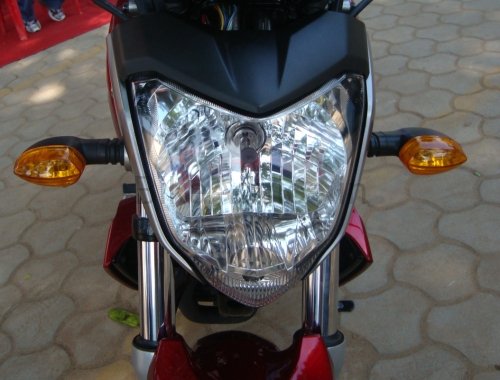
No Indian bike has a head lamp shaped like the one in FZ16. Yamaha has always tried different head lamps with its bikes, and this one is a sure winner.
The dashboard is a little disappointing for me. Muscular bikes have analog meters. This one looks as if this is a toy bike. Sorry for the FZ16 lovers, but this is the part of the bike I don’t like. It features all digital stuff including tachometer, speedometer, fuel gauge, trip and odometer.

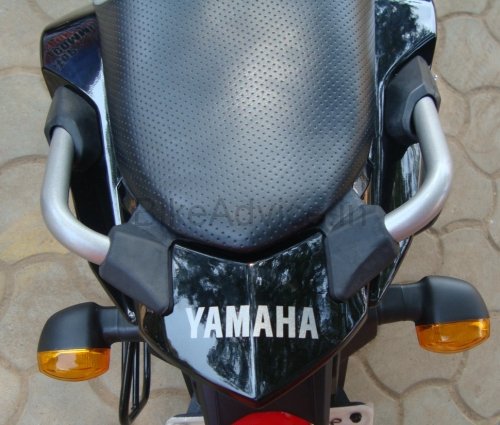
The grip bars for the pillion does not look like one at all. Yamaha has tried something new with it, fortunately, it looks very cool! And look at the sharp edge of the tail… says something!
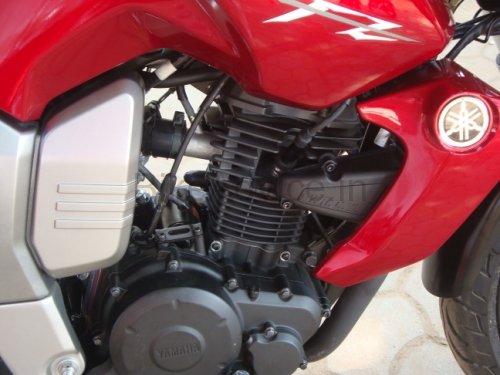
Performance: You cannot compare Yamaha FZ16 with the other premium bikes in India. The Karizma, Pulsars and R15s are for the long rides and sporty feel. But most of the Indians ride 90% of the time in city traffic. The 153cc engine of this bike is designed for the urban commute. The machine churns out 13.6 Nm of torque just at 6000 rpm. The broad tires, low center of gravity and high torque at low rpm makes it a celebration to drive in city traffic. I am sure that the so called big-bikers will be left behind once the signal turns green!
The bike covers the world standard 0-60 kmph sprint in just 5.5 seconds. The mid range thrust and the highly tuned throttle response are designed to give you the feel of a ultra-powerful bike in the urban ride. The maximum speed is 111kmph. As I said before, this bike is not for the long commutes. The seats are soft which is comfortable initially, but will yield and give you a pain in the ass if your drive for more than an hour. Strictly self start, no kicking anymore. I miss the kick. I used to kick my Karizma to start even though I had a self starter because I felt that only girls who do not have the kicking power would press a button with their thumb. But anyway, lets not blame Yamaha for that!
The open front gives you a good view of the vehicles going ahead and the broad tires help you twist and turn with ease. You can easily do stunts with Yamaha FZ16 because of the superior mass centralization and broad tires. The 267mm diameter brakes assist in doing easy stoppies. Now you too can get such a pic for your online profile! The mileage figures are not the highlights, but it is still doing good. 40kmpl in city and 54kmpl in the highways.
Verdict: Throw away your sporty looking bikes which people call sports bikes. Get real, India needs a bike like this. The mono suspension is great and can be adjusted unlike R15, which helps you to tune according to the road conditions. You may not have the money to buy Harley Davidson, you may not want to work all your life to fill the tank with ever increasing fuel prices and you may not have all the strength to handle a Bullet, but you definitely have a choice of picking a red, flaming orange or black coloured Yamaha FZ16.
Pros:
- Manly Looks
- Broad & Tubeless Radial Tires
- International Branding
- Tuned for Urban Riding
- First of its Kind in India
- Competitive Pricing (Rs.65,000 Ex-showroom)
- Six Free Services and 2-Year, 30,000 Km warranty
Cons:
- Toyish Dashbaord with Full Digital Stuff. (Would have been better with dials)
- Just three colour options
- Could have provided disc brakes for the rear tires.
Specifications:
Displacement: 153cc
Engine: Air-cooled, 4-stroke, SOHC
Maximum Power: 14bhp@7500rpm
Maximum Torque: 13.6Nm@6000rpm
Gears: 5 Manual
Weight: 126.00 kg
Ground Clearance: 160.00 mm
Fuel Tank: 12.00 ltrs
Wheelbase: 1335.00 mm
Wheel Size: 100/60 – 140/60 mm
Brakes: 267mm Hydraulic Disc
Brakes(Rear): Drum
PULSAR 220
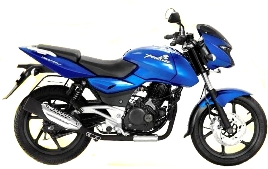
Having reviewed Yamaha R15 and Hero Honda Karizma already, I feel I have really delayed writing a review of Bajaj Pulsar 220. These three bikes are one of the best and fastest models available in India today. The bike I reviewed was Blue in color and looked gorgeous just after the water wash.
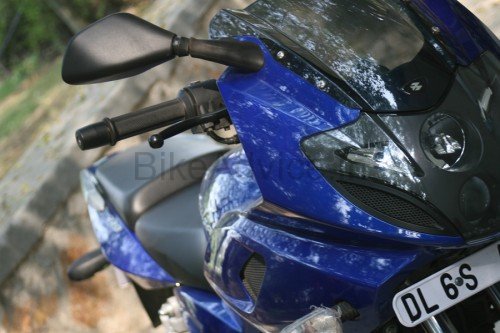
Bajaj Pulsar 220
Styling: On the first look of the bike, it looked like a cheetah ready to pounce on me. The head lamp is designed in such a way that it adds a life to the bike. It is nothing short of a face of a robot. Look at the tell tale lights, doesn’t it look like eyes? This is the second bike in India after Karizma which has isolated handle bars (like the real sports bikes). Such bikes position itself as a unique category, a higher status of machines.
The tanks are adopted from the original Pulsar and has a scratch pad near the seat. The tail part is nothing new. It just looks like the other Pulsars and it disappoints me a little bit. Someone looking just the tail wouldn’t be able to differentiate whether it is a Pulsar 220, 200, 180 or 150.
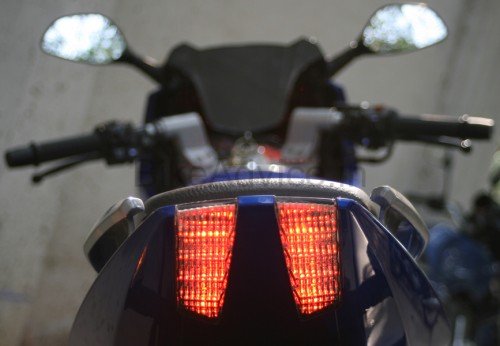
Performance and Handling: The bike has great agility. It has a tendency to ‘jump off’ when you twist the throttle which gives a great adrenaline pump. If you really want to whip the engine to its limits, the Indian city roads will disappoint you.
I own a Karizma, and when I drive the Pulsar 220, I feel as if the bike is light as a feather. There are both pros and cons to this. On my Karizma, I feel more safe and stuck to the road with the heavy solid feeling, but Pulsar 220 seems to be ‘flying’ which is good, but does not give me a safe feeling. The details may be different, but this is what I feel, and you would perhaps feel the same if you test the two bikes. The maximum power is 3 PS more than Karizma, but the top speed is nearly the same – 126 kmph.
Features: No doubt that the Pulsar places itself on par with other high end bikes. The features in the dashboard are nothing short of spectacular. With orange backlit digital console, it displays the speed, fuel level and ODO meter is incorporated below the speedometer. Like the bikes from Honda, Pulsar 220 has single indicator for the signal. The tachometer dial and the digital console perfectly blends with each other.
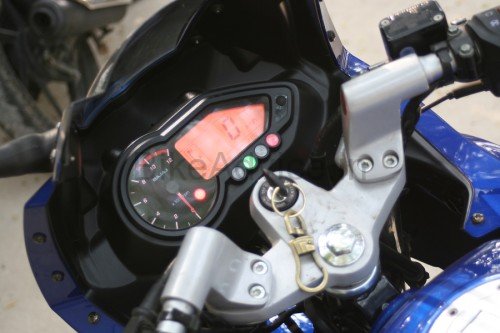
Verdict: In the test rides, the Pulsar 220 is a little faster than the Karizma, but we have to wait for Karizma Fi, a new version of Karizma that is to be launched soon. Bajaj Pulsar 220 is a great bike overall compared to the other bikes in India, but taking into account the international bikes, its stands no chance against them. Hopefully we can see lot of new technology coming up in Indian bikes in the coming years. If you want a high performance bike, wait a little longer for the new Karizma and then make the decision.
Pros: Pickup, aggressive looks, Pulsar branding
Cons: Not so pleasant engine sound
Bajaj Pulsar 220 Specifications:
Engine: 220 cc single, 2 valve, 4 Stroke, EFI, air cooled with oil cooler
Compression ratio: 12.8:1
Top speed: 135 km/h (84 mph) (estimated)
Power: 20 PS (20 hp/15 kW)
Torque: 19.13 N·m (14 ft·lbf)
Transmission: 5 speed manual sequential
Suspension: Front: 37 mm telescopic hydraulic type 130 mm (5.1 in) travel
Rear: Ellipitical section swingarm with twin hydraulic gas-charged shock absorbers; 101 mm (4 in) travel
Brakes: Front: 260mm disc
Rear: 230 mm disc
Tires: Front: 90/90-17 tubeless
Rear: 120/80-17 tubeless
Dimension: L 2,035 millimetres (80.1 in) W 750 millimetres (30 in) H 1,140 millimetres (45 in)
Weight: Approx. 150 kilograms (330 lb)
Bajaj New Pulsar 180
OTHER SPECIFICATIONS | |
| Weight: | 147.00 kg |
| Ground Clearance: | 165.00 mm |
| Fuel Tank: | 15.00 ltrs |
| Wheelbase: | 1345.00 mm |
| Electrical System: | NA |
| Headlamp: | 35W/35W Halogen |
| Horn: | NA |
| Wheel Type: | 17″ – 6 Spoke Alloys |
| Wheel Size: | 90/90 x 17″ – 120/80 × 17″ mm |
| Tubeless: |  |
| Colors: | Blue, Black, Silver, Red |
ACTIVE AND PASSIVE SAFETY | |
| Suspension(Front): | Telescopic 130mm stroke |
| Suspension(Rear): | Triple rated spring, 5 way adjustable with 101mm travel nitrox shock absorber |
| Brakes: | 260mm Disc |
| Brakes(Rear): | 130mm Drum |
| Stand Alarm: | |
COMFORT AND CONVENIENCE | |
| Fuel Guage: | Digital |
| Self Start: |  |
| Tacho Meter: | Analogue |
| Trip Meter: | None |
| Alloys: | |
| Warranty: | NA |
| Speedometer: | Digital |
| Passenger Footrest: | |
| Passenger Backrest: | |
| Step-up Seat: | |
| Pass-light: | |
| Low Fuel Indicator: | |
| Low Oil Indicator: | |
| Low Battery Indicator: | |
| High Oil Temp. Indicator: | |
| Choked Air Filter Indicator: | |
BAJAJ PULSAR 150
Prices and Review
VEHICLE SUMMARY | |||
| Name: | New Pulsar 150 | ||
| Model: | DTSi | ||
| Type: | Commuter | ||
| Top Speed: | 113kph | ||
| Fuel Consumption: City | 51.00 | ||
| Fuel Consumption: Highway | 62.00 | ||
ENGINE SPECIFICATIONS | |||
| Displacement: | 149.01cc | ||
| Engine: | 4 Stroke, DTSi | ||
| Maximum Power: | 14 Bhp @ 8500 rpm | ||
| Maximum Torque: | 12.7 Nm @ 6500 rpm | ||
| Gears: | 5 Speed | ||
| Clutch: | Wet Multiplate Clutch | ||
| Bore: | NA | ||
| Stroke: | NA | ||
| No. of Cylinders: | 1 | ||
| Cylinder Configuration: | NA | ||
| Engine Block Material: | NA | ||
| Chassis Type: | Double Cradle | ||
| Cooling Type: | Air Cooling | ||
| Carburetor: | NA | ||
DIMENSIONS | |||
| Length: | 2035.00 mm | ||
| Width: | 750.00 mm | ||
| Height: | 1115.00 mm | ||

OTHER SPECIFICATIONS | |
| Weight: | 143.00 kg |
| Ground Clearance: | 165.00 mm |
| Fuel Tank: | 15.00 ltrs |
| Wheelbase: | 1320.00 mm |
| Electrical System: | NA |
| Headlamp: | 35W/35W Halogen |
| Horn: | NA |
| Wheel Type: | 17″ Black Alloys |
| Wheel Size: | 90/90 x 17″ – 100/90 × 17″ mm |
| Tubeless: | |
| Colors: | Black, Silver, Blue & Red |
ACTIVE AND PASSIVE SAFETY | |
| Suspension(Front): | Telescopic Forks |
| Suspension(Rear): | Triple rated spring, 5 way adjustable with 105mm travel nitrox shock absorber |
| Brakes: | 240mm Disc |
| Brakes(Rear): | 130mm Drum |
| Stand Alarm: | |
COMFORT AND CONVENIENCE | |
| Fuel Guage: | Digital |
| Self Start: | |
| Tacho Meter: | Analogue |
| Trip Meter: | None |
| Alloys: | |
| Warranty: | NA |
| Speedometer: | Digital |
| Passenger Footrest: | |
| Passenger Backrest: | |
| Step-up Seat: | |
| Pass-light: | |
| Low Fuel Indicator: | |
| Low Oil Indicator: | |
| Low Battery Indicator: | |
| High Oil Temp. Indicator: | |
| Choked Air Filter Indicator: | |
Subscribe to:
Posts (Atom)